Future careers can feel abstract before GCSE choices and visible project experience.
Product case study · completed first programme milestone
Freedom Writers
Turning a distant career-guidance idea into a familiar creative starting point for young people.
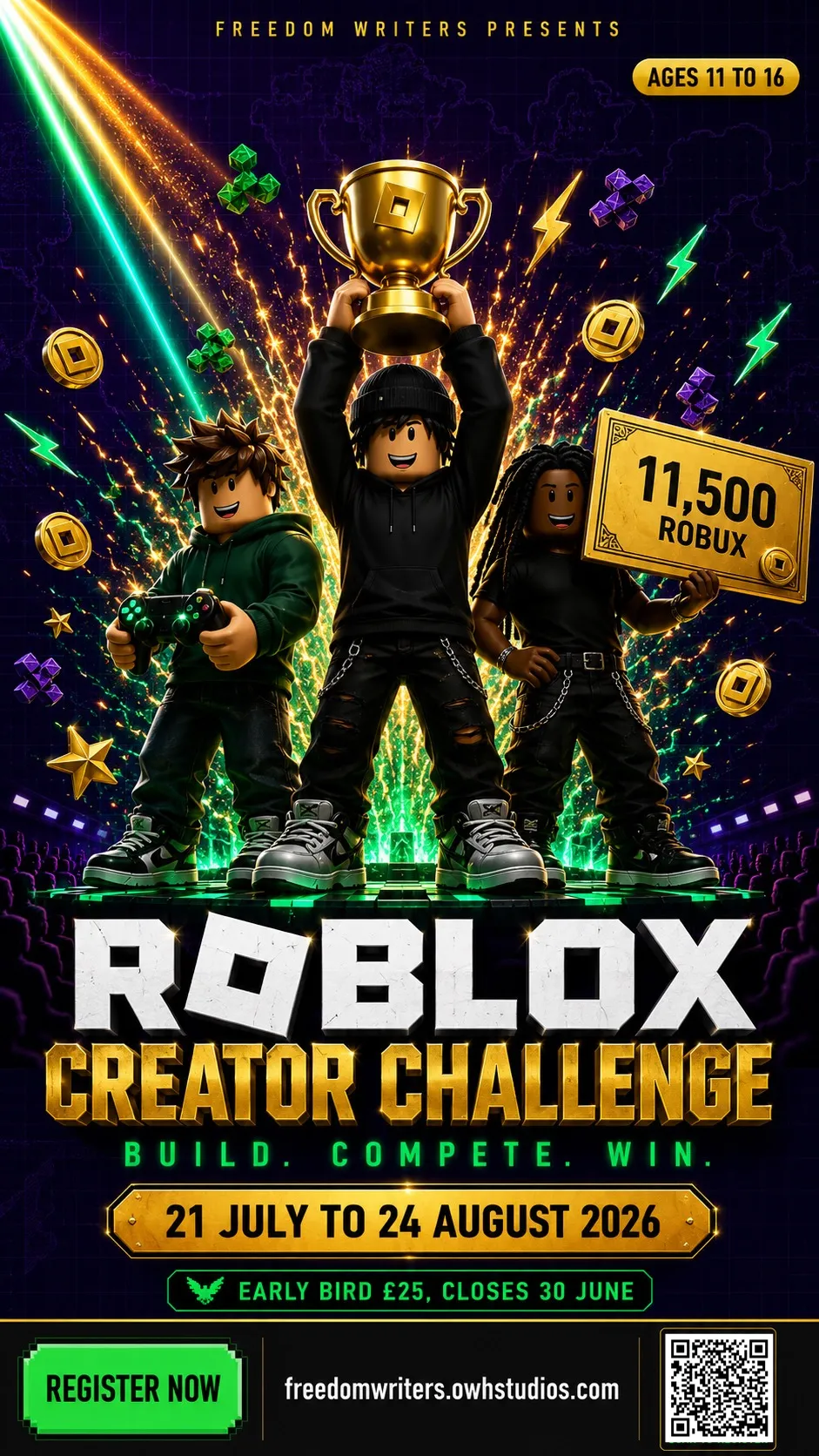
Roblox Young Creator Challenge11 to 16
Five weeks of digital creation, guided learning and portfolio-building.
- Project
- Freedom Writers
- Role
- Product Owner and Programme Director
- Organisation
- Odeh and Wisdom Holdings
- Milestone
- Roblox Young Creator Challenge 2026
- Status
- Completed first programme milestone
- Audience
- Young people, parents, schools and partners
02 · The problem
Potential is not the same as visible opportunity.
Young people may have significant creative and technical potential while lacking relatable routes into digital creation, technology and future careers.
This matters differently across the ecosystem. Young people need a starting point that feels possible. Parents need trust and safety. Schools need a credible student opportunity. Freedom Writers needs to turn a social-enterprise mission into a product that can be understood, delivered and measured.
A useful opportunity still needs clear safeguarding, consent, cost and delivery information.
Student value, practical requirements and trust signals must be easy to assess.
The mission needed a bounded first product, not only an ambitious idea.
03 · Original concept and product pivot
The answer changed when the audience became more specific.
Original concept
AI career-guidance platform
A platform for helping young people understand future opportunities and possible pathways.
Product riskThe proposition could feel too abstract or distant for an 11 to 16-year-old who had not yet completed their GCSEs.
Product questionWhat do they already love?
Start with familiar behaviour, then build wider capability around it.
Delivered first milestone
Roblox Creator Challenge
Game creation became the entry point for digital skills, guided AI-tool practice, project work and a portfolio outcome.
Reasoned decisionRoblox was selected as a motivating starting point, not presented as the only or inevitable answer.
04 · Users and stakeholders
One programme created several different product journeys.
Each group needed different information, permissions and trust signals. Treating them as one audience would have hidden important product requirements.
GroupPrimary needProduct response
Young participantsA motivating entry point, clear weekly goals and visible recognition for progress.Youth-facing challenge content, Roblox creation, Freedom Points, peer participation and a finished portfolio project.
Parents and guardiansConfidence in safety, consent, cost, communication and what participation involved.A separate parent journey with consent, safeguarding, programme information and payment planning.
Schools and senior leadersA concise explanation of student value, delivery expectations, safeguarding and how to refer interest.A dedicated School and SLT information pack, partnership pathway and downloadable historical materials.
Programme instructorsA teachable weekly sequence, clear participation expectations and a manageable first cohort.A five-week structure moving from foundations to publication, supported by weekly tasks and drop-in activity.
Internal delivery teamShared scope, coordinated content, website requirements and clear hand-offs across a small team.A constrained first milestone with prioritised journeys, campaign content and explicit operational responsibilities.
Safeguarding responsibilityAge-appropriate permissions, parental consent, moderated spaces and a clear reporting route.A named safeguarding lead, parent-controlled registration, age-aware platform permissions and preserved policy material.
05 · Kevin's role
Product ownership connected the mission to a deliverable first milestone.
Kevin owned product direction, programme definition, digital journey requirements and evidence review.
Delivery was shared. Kevin coordinated a small team, instructor needs and external-facing material; the case does not attribute every programme or campaign task exclusively to him.
Set the first milestone and connected the programme, digital journeys and evidence needs.
Translated a broad access problem into a product question that could be tested through delivery.
Reviewed comparable offers and differentiated the needs of young people, parents and schools.
Structured the five-week challenge, participation model and supporting reward system.
Defined the customer-facing information, registration, payment and archive needs.
Separated youth motivation from parent trust, consent and practical information.
Chose the smallest coherent first milestone and deferred broader platform ambitions.
Mapped consent and payment flows while preserving unresolved historical conflicts.
Reviewed customer-facing journeys and requirements before launch.
Analysed six TikTok posts and documented both the pattern and its confounds.
Coordinated a two-person delivery team, instructor needs and external stakeholder material.
Reviewed evidence gaps and converted the completed programme into a transparent product case.
06 · Constraints
The operating environment shaped the product.
A small delivery team with limited capacity for the first programme milestone.
Safeguarding and parental consent requirements for an audience aged 11 to 16.
Trust and credibility requirements across young people, parents, schools and partners.
A time-bound summer programme with different levels of participant technical experience.
Historical pricing and registration records that do not fully agree with one another.
A six-post campaign sample that is too small for causal or statistical claims.
No validated participant outcome dataset for skill development or longer-term impact.
A commitment to keep substantive learning resources freely available.
07 · Product and programme architecture
The experience joined motivation, trust, learning and delivery.
The website was one part of a wider service. The programme only made sense when the public journeys, weekly learning, permissions and operations connected.
Young creatorsParents and guardiansSchools and partners
Website and communication layer
Challenge motivationParent informationSchool PackFree resourcesCampaign content
Registration and paymentsProgramme instructionCampaign measurementArchive and learning
08 · Prioritisation and trade-offs
The first milestone was shaped by deliberate limits.
Product decision
Start with a constrained programme
- Decision
- Define a five-week Creator Challenge instead of attempting a large open-ended platform first.
- Why
- A bounded programme made the learning sequence, delivery responsibility and first milestone easier to coordinate.
- Trade-off
- The first release served a narrow cohort and deferred a broader always-on platform.
Product decision
Use Roblox as the entry point
- Decision
- Lead with a platform many young people already understand, then introduce digital creation and AI-tool confidence through building.
- Why
- The original AI career-guidance concept risked feeling distant to young people who had not yet completed their GCSEs.
- Trade-off
- The programme became more accessible, but its first milestone was intentionally tied to one creative platform.
Product decision
Design two public journeys
- Decision
- Separate youth-facing motivation from parent-facing trust, consent and programme information.
- Why
- The participant and the purchasing or consenting adult had different questions, permissions and reasons to act.
- Trade-off
- More content and testing were required to keep both journeys consistent.
Product decision
Make progress visible
- Decision
- Use Freedom Points to recognise building, development and contribution across the programme.
- Why
- A reward structure connected weekly participation with visible progress and peer contribution.
- Trade-off
- The system added operational tracking and required careful explanation of historical rewards.
Product decision
Keep free learning visible
- Decision
- Preserve free resources alongside the paid programme pathway.
- Why
- The wider mission was not limited to people who could join the first cohort.
- Trade-off
- The product had to support both a programme journey and an open resource library.
Product decision
Archive instead of relaunching expired flows
- Decision
- Retire registration and payment routes while preserving historical programme evidence.
- Why
- Expired dates, prices and inconsistent registration records should not appear to be a current offer.
- Trade-off
- The archive prioritises accuracy over direct conversion.
What was deliberately deferred or not built
A broad always-on career-guidance platform, a larger open-ended cohort model, validated school partnership reporting, controlled campaign experimentation and a participant outcome measurement system all remained outside the first milestone.
09 · Design and delivery process
A truthful sequence from idea to evidence review.
- 01
Initial idea
Frame access to visible digital and career opportunities as the core problem.
- 02
Audience and competitor research
Review comparable offers and distinguish the needs of young people, parents and schools.
- 03
Programme definition
Turn the opportunity into a bounded five-week Roblox Creator Challenge.
- 04
Journey and content design
Design separate motivation, trust, consent, school and resource pathways.
- 05
Build and integration planning
Define website requirements, registration, payment, content and programme operations.
- 06
User testing
Review the customer-facing journeys and requirements before public launch.
- 07
Launch and delivery
Run the 2026 first programme milestone and publish supporting campaign content.
- 08
Campaign measurement
Analyse six TikTok posts and document both observed figures and confounds.
- 09
Post-milestone review
Identify evidence gaps, historical conflicts and what a stronger next measurement plan needs.
- 10
Portfolio transformation
Preserve the completed milestone while reframing it as one product case within a wider portfolio.
10 · Campaign evidence
Six posts created a useful baseline, not an impact verdict.
TikTok Studio, 20 June to 14 July 2026. The figures describe reach and engagement for the first six posts. They do not measure participant learning or programme impact.
5,055documented
views across six posts
What this means
Caveat: Campaign reach; not evidence of student learning or programme impact.
204documented
likes across six posts
What this means
Caveat: Platform engagement only.
7documented
comments across six posts
What this means
Caveat: Small sample; interpret descriptively.
4.2%documented
overall engagement
What this means
Caveat: Campaign engagement; methodology should be retained with source export.
1.0% → 8.8%documented
engagement range across the campaign
What this means
Caveat: Descriptive six-post trend, not a causal result.
87.3%documented
For You traffic
What this means
Caveat: Platform distribution metric.
5.6% vs 1.5%documented
early pattern across 6 posts
What this means
Caveat: Hook-led posts averaged 5.6% engagement versus 1.5% for direct announcements. This small sample suggests what to test next; it is not a proven result.
11 · Directional hypothesis
Directional working hypothesis, n=6, not statistically validated
Posts using an emotional or rhetorical hook averaged higher engagement than direct programme announcements within this small sample.
Only six posts were compared, split between two announcement posts and four hook-led posts.
Later posts also benefited from a more established account and possible platform learning.
The follower base changed during the period, so distribution conditions were not fixed.
Date, time, caption length and hashtags varied alongside content type.
No causal claim
The comparison suggests what to test next. It does not show that hook style caused higher engagement.
12 · Outcome and impact
Verified outcomes stay separate from planned outcomes.
Verified
- A public website and five-week programme structure were created.
- The Roblox Young Creator Challenge 2026 milestone was run and then archived.
- Programme, parent, safeguarding and school-facing materials were produced.
- Six campaign posts generated 5,055 views, 204 likes and 7 comments.
- Overall campaign engagement was 4.2%, with 87.3% of traffic from the For You page.
- Discovery occurred beyond the existing follower base.
Not claimed
- A 30-participant target appears in historical planning material, but achievement is not evidenced.
- No measured participant skill improvement percentage is available.
- No school partnership, revenue, conversion or retention outcome is claimed.
- The content comparison is directional and cannot establish causation.
Authentic project artifact
School and SLT Information Pack 2026
The preserved eight-slide pack explains the origin story, five-week structure, Freedom Points, safeguarding and proposed school pathway. Dates, prices, capacity and partnership promises remain historical.
13 · What did not work or remains unresolved
The first milestone exposed the evidence needed for a stronger next iteration.
Historical pricing conflict
Archived materials show different programme prices. The portfolio preserves the conflict rather than choosing a definitive figure.
Registration-state inconsistency
Historical status records do not consistently describe capacity and closure. Current registration remains closed.
Small campaign sample
Six posts are insufficient for reliable statistical comparison or causal attribution.
No controlled experiment
Posting date, account maturity, audience growth, timing, captions and hashtags varied alongside content type.
Missing participant outcomes
The first milestone did not produce a validated baseline and follow-up dataset for learning outcomes.
Video accessibility review
The five preserved videos do not have approved synchronised captions or verified verbatim transcripts.
14 · Learning and next iteration
Measurement needs to be part of the product before launch.
Audience framing
A familiar creative entry point can make a future-facing opportunity easier to understand.
Trust is part of the product
For youth programmes, parent information, safeguarding and permissions are core journey requirements.
Evidence must be designed before launch
Baseline, follow-up and experiment fields should be agreed before delivery, not reconstructed afterwards.
Content experiments need controls
A promising pattern is useful for deciding what to test next, but not for claiming what caused an outcome.
Scope protects delivery
A constrained first milestone made the product buildable for a small team and exposed what should remain deferred.
Stakeholders need different explanations
Young people, parents, schools and delivery partners require distinct language, proof and calls to action.
Next step
Explore the completed programme evidence.
The archive preserves the challenge structure, parent information, videos, School Pack, safeguarding and historical campaign material without presenting registration as current.